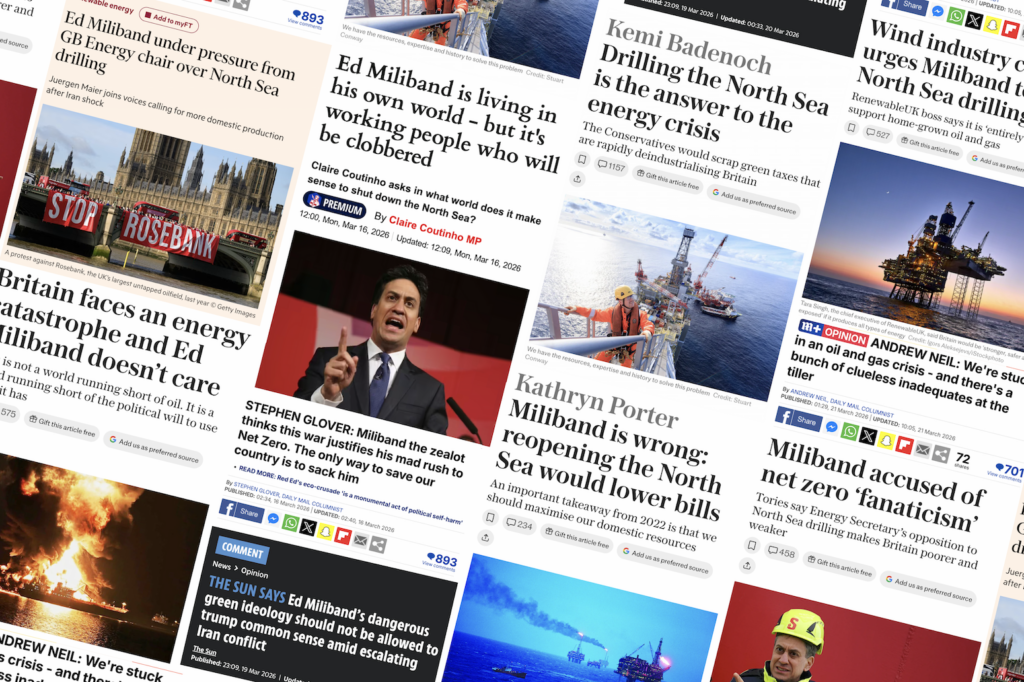
The critical perspective flags coordinated messaging, selective evidence, and emotive framing as signs of manipulation, while the supportive perspective highlights multiple verifiable citations, balanced debunking, and transparent acknowledgment of disinformation. Weighing the concrete, independent sources cited by the supportive side against the pattern‑based observations of the critical side, the evidence for credibility appears stronger, suggesting a lower overall manipulation score than the critical view proposes.
Key Points
- Both analyses note the article uses authority quotes and references energy‑policy data.
- The supportive perspective provides specific, verifiable citations (CCC, Oxford Institute, UK government) that substantiate its claims.
- The critical perspective points to uniform phrasing across outlets and AI‑generated accounts, but these observations are indirect and pertain to broader media coverage rather than the article itself.
- Emotive language is present in both views, yet its impact depends on context; the supportive side argues it is descriptive rather than fear‑mongering.
- Overall, the balance of concrete source evidence outweighs pattern‑based manipulation signals, leading to a lower manipulation assessment.
Further Investigation
- Examine the original Carbon Brief article to verify the presence and context of authority quotes and emotive language.
- Check the cited sources (CCC report, Oxford Institute analysis, UK government factsheet) for accuracy and relevance to the claims made.
- Analyze the alleged coordinated messaging across other outlets to determine if it directly influences the article's framing or is a separate phenomenon.
The article employs coordinated messaging, selective evidence, and emotive framing to push a pro‑drilling narrative while dismissing opposing viewpoints as false or misleading. It also leverages authority figures, urgency cues, and AI‑generated fake accounts to amplify the claim that reopening the North Sea will lower energy bills.
Key Points
- Uniform phrasing across disparate outlets (e.g., “Open up the North Sea. Immediately.”) suggests coordinated messaging.
- Appeals to authority and urgency are used to lend credibility and pressure readers (quotes from Trump, a self‑described “energy consultant”, and political leaders).
- Selective presentation of data and omission of broader context (e.g., emphasizing a marginal 1% supply impact while ignoring climate costs and long‑term market dynamics).
- Use of emotionally charged language (“energy crisis”, “bills soaring”) to heighten fear and create a false dilemma between drilling and high bills.
- Reference to AI‑generated posts from fake accounts that typically spread anti‑immigrant/anti‑Muslim content, indicating a possible disinformation amplification network.
Evidence
- "Open up the North Sea. Immediately. Your energy prices are through the roof." – quoted from Donald Trump to the Sun.
- "Reopening the North Sea would lower bills" – repeated headline across Daily Express, Daily Telegraph, and Reform Party tweets.
- "Even if all proven UK reserves and resources of gas from new fields were extracted, this would only meet about 1% of European demand each year up to 2050" – used to downplay the impact of additional drilling while the article still pushes the drilling narrative.
- "These arguments have also been amplified in AI‑generated posts on social media, shared by fake accounts that usually post anti‑immigrant and anti‑Muslim content." – explicit claim of coordinated fake‑account amplification.
- "The Labour government has made similar arguments, saying in a ‘factsheet’ on the Iran crisis that the UK is a ‘price‑taker…not a price‑maker’" – framing the government’s stance as factual while labeling opposing views as false.
The piece reads like a standard fact‑check: it cites multiple independent sources, presents counter‑arguments, and transparently labels disputed claims as false or misleading. Its tone is explanatory rather than polemical, and it discloses the role of AI‑generated disinformation without endorsing any side.
Key Points
- Multiple verifiable citations (CCC report, Oxford Institute for Energy Studies, UK government factsheet) are provided for each claim.
- The article systematically debunks specific assertions, labeling them false or misleading and explaining why, which shows a balanced, corrective intent.
- It acknowledges the existence of coordinated disinformation (AI‑generated fake accounts) rather than ignoring it, indicating self‑awareness of manipulation attempts.
- Language remains largely informational; emotive terms are limited to describing the broader context (e.g., "energy crisis") rather than inciting fear.
- The author affiliation (Carbon Brief) is a recognized specialist outlet on climate and energy, and the article follows its typical editorial standards.
Evidence
- Reference to the Climate Change Committee (2022) stating UK extraction would not materially affect global prices.
- Quote from Jack Sharples, senior research fellow at the Oxford Institute for Energy Studies, explaining limited impact on bills.
- Citation of the UK Labour government's factsheet describing the UK as a "price‑taker" in international markets.