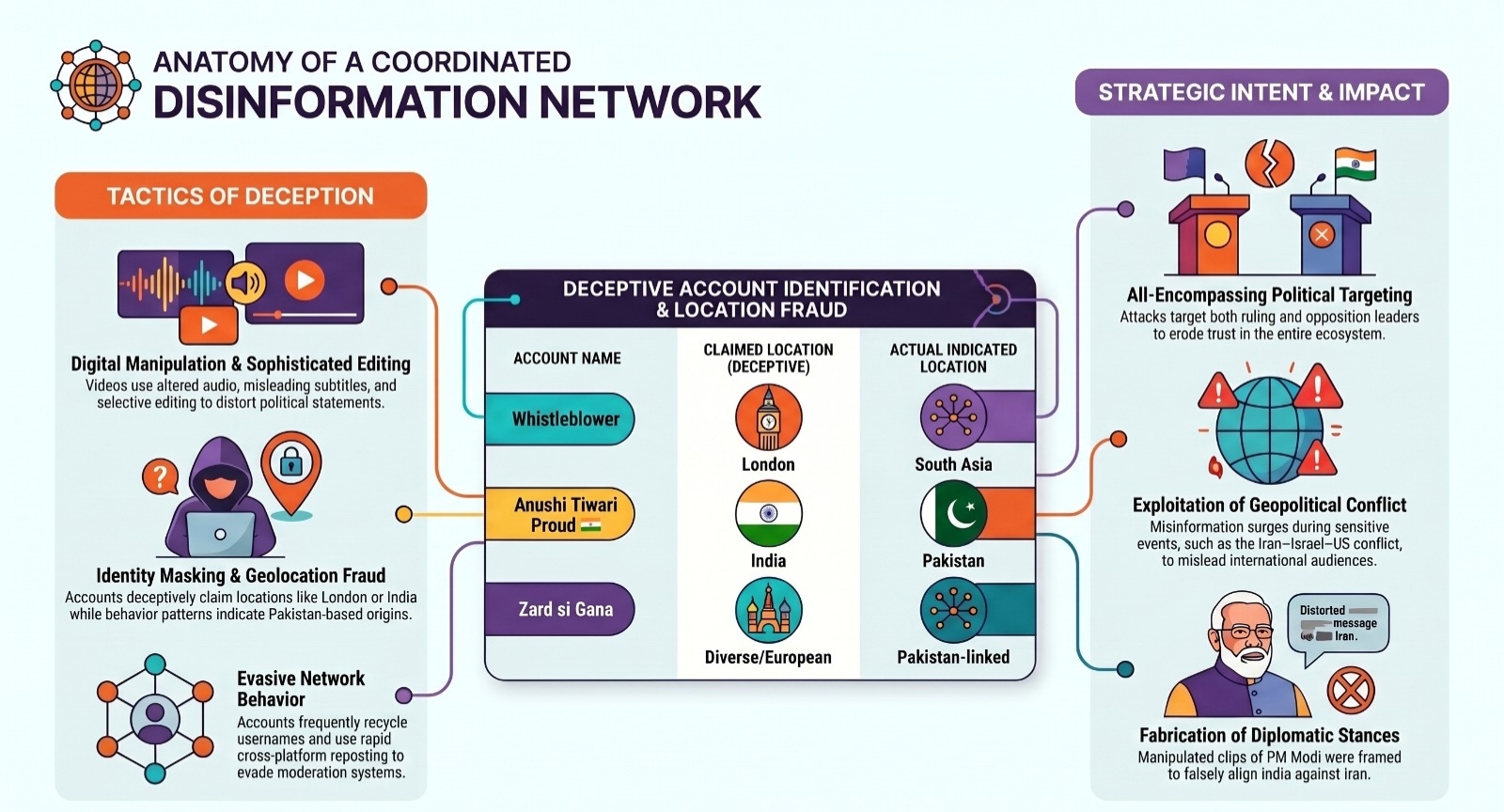
Both analyses agree the text is structured like an investigative brief and cites specific fabricated videos, but they diverge on intent. The critical perspective emphasizes coordinated messaging, loaded framing, and selective omission as signs of deliberate manipulation, while the supportive perspective notes the absence of verifiable citations and occasional bias, suggesting a mixed authenticity profile. Weighing the detailed manipulation cues against the lack of source verification leads to a moderate‑high suspicion of manipulation.
Key Points
- The text uses emotionally charged terms (e.g., “escalate,” “betrayer”) and uniform hashtags, which the critical perspective flags as coordinated amplification.
- Both perspectives note concrete examples (e.g., a fake video of Defence Minister Rajnath Singh) that could be independently verified, but no citations are provided.
- The supportive perspective highlights a systematic layout typical of genuine reports, yet also acknowledges the lack of official confirmation, aligning with the critical view of selective evidence.
- Evidence of timing links between misinformation spikes and real events is presented, but without methodological detail, leaving its analytical rigor uncertain.
Further Investigation
- Obtain the original videos and conduct forensic analysis to confirm manipulation.
- Identify the accounts spreading the hashtags and trace their network to assess coordination.
- Seek official statements from Indian ministries regarding the alleged endorsements to verify or refute the claims.
The text employs loaded framing, selective evidence, and coordinated‑messaging cues that suggest a deliberate manipulation narrative aimed at portraying India as a hostile actor. It uses emotional language, uniform hashtags, and timing references to amplify a hostile perception while omitting counter‑vailing official statements.
Key Points
- Loaded terminology (e.g., “escalate,” “surge in misinformation,” “covert ally,” “betrayer”) frames India negatively.
- Uniform messaging and repeated hashtags (#IndiaBetraysIran, #BahrainArrestsIndianSpy) indicate coordinated amplification.
- Selective omission of India’s official neutral stance creates a false dilemma between “supporting Israel aggressively” or “remaining neutral.”
- Attribution asymmetry: fabricated videos are described with specific Indian officials, while the source (Pakistani operators) is vaguely referenced.
- Timing links spikes in false content to real‑world events, suggesting strategic deployment to shape perception.
Evidence
- "A manipulated video falsely depicting Defence Minister Rajnath Singh endorsing US military actions against Iran."
- "The campaign consistently pushed a set of coordinated narratives portraying India as: A covert ally of Israel; A betrayer of Iran; An aggressor in regional geopolitics."
- "These narratives appeared strategically tailored to resonate with audiences in Muslim‑majority countries and the Global South."
- "Uniform messaging... multiple outlets and accounts repeat identical phrasing and hashtags (#IndiaBetraysIran, #BahrainArrestsIndianSpy) within minutes."
- "Timing... links misinformation spikes to real‑world events (e.g., the March 4 2026 surge after the sinking of IRIS Dena)."
The content shows several hallmarks of a genuine investigative brief—clear structure, enumerated findings, and concrete examples of alleged disinformation—yet it lacks verifiable citations and occasionally employs loaded language, suggesting a mixed authenticity profile.
Key Points
- The report follows a systematic layout (Key Findings, numbered sections) typical of professional analyses.
- It provides concrete, traceable examples (e.g., manipulated videos of specific Indian officials) rather than vague assertions.
- The authors acknowledge the absence of official confirmation for the alleged statements, indicating an attempt at balanced reporting.
- Temporal links are drawn between misinformation spikes and real‑world events, a standard analytic practice for disinformation studies.
Evidence
- Section headings such as "1.Systematic use of digitally manipulated videos" and numbered bullet points mirror standard investigative reports.
- Specific fabricated content is described (e.g., a video of Defence Minister Rajnath Singh endorsing US actions), allowing external verification.
- The text repeatedly notes that "These claims are not supported by official statements or verified sources," which signals awareness of evidentiary limits.