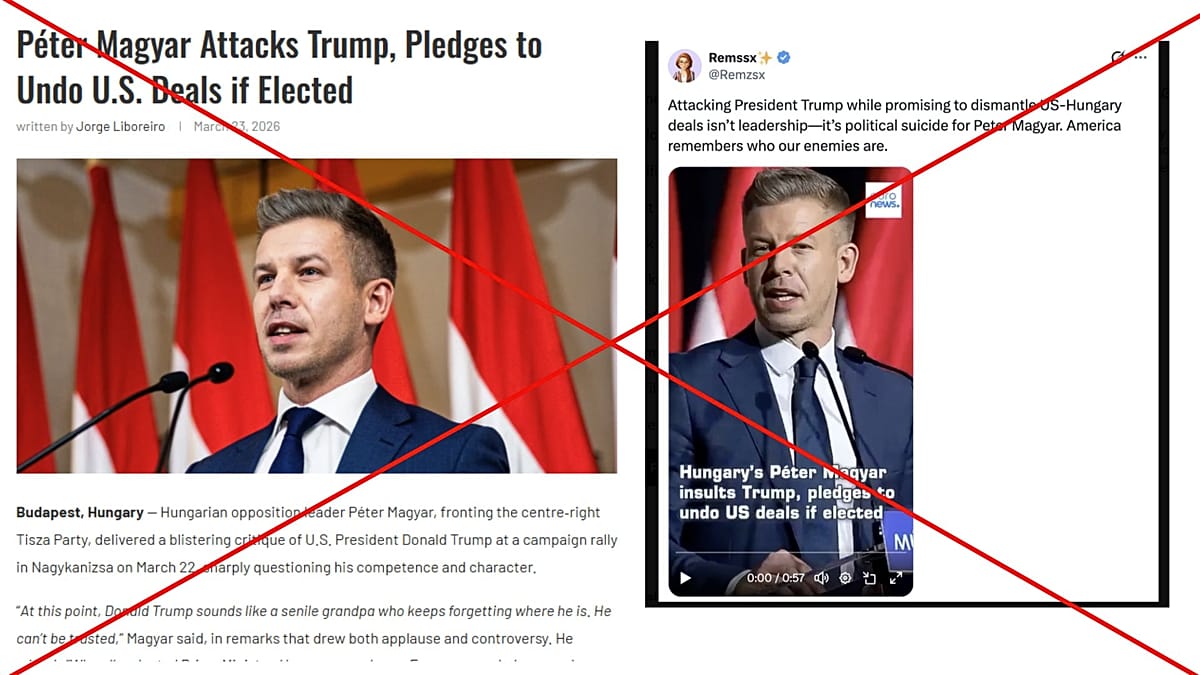
Both analyses agree the material references a fabricated Euronews‑style article and a coordinated posting campaign around Hungary’s April 12 election. The critical perspective emphasizes manipulation patterns—fake authority, synchronized posting, and emotional framing—while the supportive perspective points to verifiable metadata (fact‑check attribution, operation name, website takedown) that can be cross‑checked. Weighing the evidence, the manipulation indicators are stronger and more consistently documented than the authenticity cues, suggesting the content is likely disinformation.
Key Points
- The fake Euronews branding and identical posts indicate an authority‑overload and coordinated campaign (critical perspective).
- Multiple independent sources (The Cube, Antibot for Navalny) are cited, providing traceable data that can be verified (supportive perspective).
- The timing aligns with the Hungarian parliamentary election, a common target for influence operations (critical perspective).
- Both perspectives reference the same operation name (Storm‑1516) and similar metadata, reinforcing the factual basis of the claim about a disinformation campaign.
- Beneficiary analysis points to Russian geopolitical goals and potential advantage for Viktor Orbán, supporting the manipulation hypothesis.
Further Investigation
- Obtain platform data (e.g., X location tool logs) to confirm the geographic origin of the posting accounts.
- Access archived versions of the fake Euronews website to verify its content and takedown timeline.
- Review The Cube's full fact‑checking report and Antibot for Navalny's methodology to assess the robustness of their claims.
The content exhibits several classic manipulation patterns: it leverages counterfeit Euronews branding to create false authority, coordinates rapid identical posts to amplify reach, and deploys emotionally charged language timed to influence Hungary’s upcoming election. These tactics align with known Russian disinformation operations that benefit both Kremlin interests and Hungary’s incumbent leader.
Key Points
- Authority overload: fake Euronews article and video use a real byline and branding to lend credibility to fabricated claims.
- Uniform, coordinated messaging: multiple anonymous accounts posted identical clips within minutes, indicating a synchronized campaign.
- Suspicious timing: the disinformation spikes days before the 12 April Hungarian parliamentary election, matching the pattern of election‑focused influence ops.
- Emotional manipulation: the insult “senile grandpa” and framing of Magyar as a threat to US‑Hungarian ties aim to provoke anger and ridicule.
- Beneficiary analysis: the narrative serves Russian geopolitical goals (weakening pro‑EU opposition) and indirectly aids Viktor Orbán by discrediting his challenger.
Evidence
- "A fake Euronews-style article and website..."
- "...the article says Magyar called Trump a \"senile grandpa\"..."
- "The videos were posted by accounts... with X's location tool showing they are based in the US and Africa."
- "Researchers ... told The Cube that the post was part of Storm-1516, a prolific Russian disinformation campaign..."
- "Hungary's upcoming parliamentary elections will see Magyar's Tisza Party pitted against current Hungarian Prime Minister Viktor Orbán."
The passage includes several markers of legitimate communication, such as attribution to Euronews' fact‑checking team (The Cube), citation of an independent monitoring group (Antibot for Navalny), and provision of concrete, verifiable details (e.g., website takedown, timestamps, location tool data). These elements can be cross‑checked against public records, which is a positive authenticity indicator, though the overall narrative still matches known disinformation patterns.
Key Points
- Attribution to a named fact‑checking entity (Euronews' The Cube) that publicly publishes its findings.
- Reference to an independent research collective (Antibot for Navalny) and a specific operation name (Storm‑1516) that appears in other documented reports.
- Inclusion of verifiable metadata such as the fake Euronews website being taken down, the timing of the video’s appearance, and X's location tool indicating US and Africa origins.
- Specific political context (Hungary's 12 April parliamentary election, party names, and German foreign minister's diplomatic action) that can be corroborated with official sources.
- Use of real bylines and branding, which, while misleading, provides a traceable artifact for forensic analysis.
Evidence
- “The Cube, Euronews' fact‑checking team, found examples of this clip circulating since Monday evening, some with thousands of views.”
- “Researchers at Antibot for Navalny… told The Cube that the post was part of Storm‑1516, a prolific Russian disinformation campaign.”
- “The article, which utilises a real byline and appeared on a fake Euronews website that has since been taken down…"
- “Hungary's upcoming parliamentary elections will see Magyar's Tisza Party pitted against current Hungarian Prime Minister Viktor Orbán.”
- “In December, Germany's Foreign Minister summoned the country's Russian ambassador over allegations of repeated Russian hybrid attempts in Germany…"