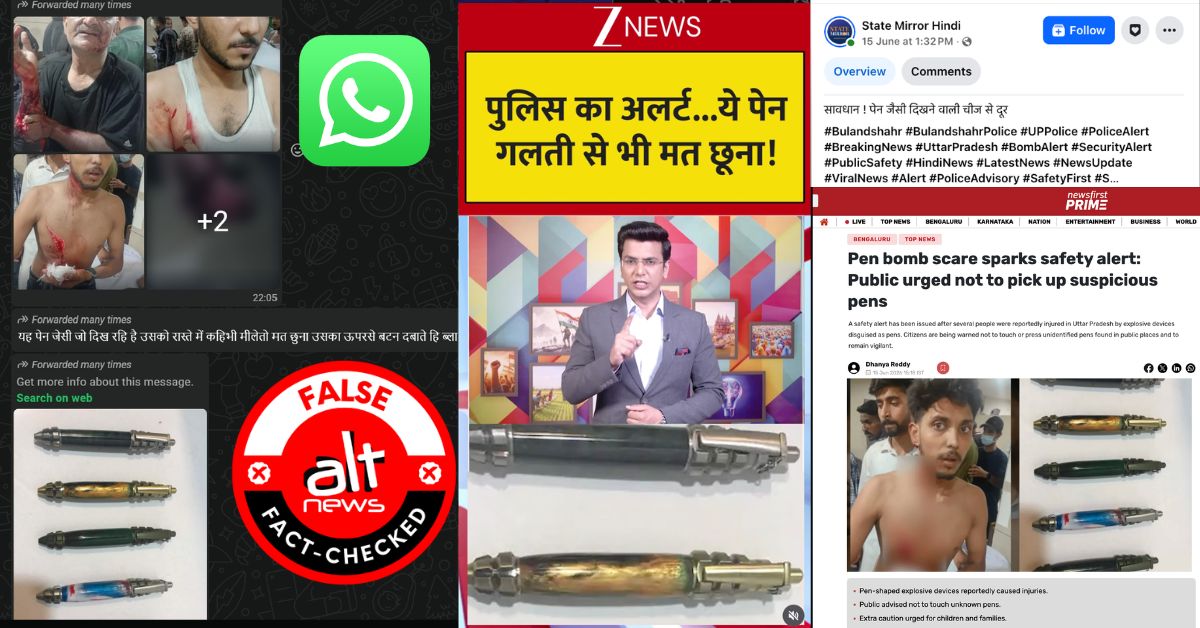
Both analyses agree that the alleged explosive‑pen story is unfounded: a novelty Etsy pen was mis‑portrayed, and police agencies have publicly denied any advisory. The critical perspective highlights how the original rumor employs fear‑based language, false authority cues, and coordinated imagery to spur sharing, which are classic manipulation tactics. The supportive perspective shows that the fact‑checking article follows transparent, verifiable methods (official X statements, reverse‑image search, cited URLs), indicating it is a credible corrective effort. Thus, manipulation is evident in the rumor itself, not in the debunking content.
Key Points
- The pen image matches a commercial Etsy listing, confirming it is a novelty item (both perspectives).
- Bulandshahr Police and Raipur Police Commissionerate explicitly denied issuing any advisory, undermining the rumor's authority claim (both perspectives).
- The rumor uses fear‑inducing phrasing and uniform visuals across outlets, fitting manipulation patterns identified by the critical perspective.
- The fact‑check article provides direct screenshots, timestamps, and reproducible investigative steps, aligning with standard verification practice noted by the supportive perspective.
- Manipulative elements reside in the original claim, while the corrective piece appears credible and aims to reduce panic.
Further Investigation
- Obtain any official police advisory documents (if they exist) to conclusively confirm the absence of an issuance.
- Verify the timestamps and authenticity of the X posts cited by the supportive perspective to ensure they are not fabricated.
- Map the spread of the original rumor across platforms to quantify coordination and identify primary sources.
The content employs fear‑based language, urgent calls‑to‑action, and fabricated authority citations to spur rapid sharing, while omitting key factual context that disproves the claim. Coordinated use of identical images and headlines across multiple outlets further amplifies the manipulation effect.
Key Points
- Appeal to fear and urgency (“Anyone who presses the button… will cause it to explode…”, urging forward‑to‑every‑group)
- False authority overload – repeated claims of police advisories that were later denied by the same agencies
- Bandwagon and uniform messaging – identical pen image and headline used by several media outlets, creating a perception of consensus
- Selective omission of verifiable facts – reverse‑image search shows the pen is a novelty Etsy product, but this is excluded from the viral warning
- Attribution asymmetry – “Bulandshahr Police” is presented as warning source, while police statements that refute the claim are framed as “rumour‑control”
Evidence
- "Anyone who presses the button on top of this pen will cause it to explode, causing injuries to the face, hands, or body."
- "Citizens have been urged to stay away from suspicious objects resembling pens..." (quoted as Bulandshahr Police advisory)
- "The police clarified that neither the district magistrate nor the senior superintendent of police in Bulandshahr had issued any advisory"
- "We performed a reverse image search… the same image was found on Etsy… described as a military novelty tank or grenade ink pen"
- "Multiple outlets used the same headline phrasing… indicating coordinated messaging"
The piece demonstrates several hallmarks of legitimate communication: it cites verifiable official sources, provides transparent investigative steps (reverse‑image searches, tweet screenshots), and explicitly notes the absence of any police advisory. These practices align with standard fact‑checking methodology rather than disinformation tactics.
Key Points
- Direct quotations and screenshots from the official X accounts of Bulandshahr Police and Raipur Police Commissionerate refute the alleged advisory.
- A systematic reverse‑image search links the viral pen photo to a commercial Etsy listing, showing the object is a novelty ink pen, not an explosive device.
- Alt News documents its investigative process (helpline verification, source tracing) and supplies URLs and timestamps, enabling independent replication.
- The article includes a clear correction narrative, warning readers not to share the rumor, which is characteristic of responsible public‑interest communication.
Evidence
- Bulandshahr Police’s X reply explicitly states no advisory was issued (tweet quoted in the article).
- Raipur Police Commissionerate’s X post (June 18 2026) declares the story a panic‑inducing rumor and urges the public not to circulate it.
- Etsy listing for a "military‑style grenade ink pen" sold by Penatradition, matching the viral image, with no mention of explosives.