Both perspectives note that the posts contain official‑sounding statements and specific data, but the critical view highlights repeated emotional language, identical phrasing across accounts and explicit calls for viral sharing, which are typical manipulation cues. The supportive view points to verifiable quotes, media citations and detailed exam figures that could legitimize the content. Weighing the evidence, the coordination signals raise suspicion, while the presence of concrete official information tempers it, leading to a moderate manipulation rating.
Key Points
- Identical wording and emotional triggers suggest coordinated framing (critical)
- Official quotes, media citations and precise statistics provide verifiable anchors (supportive)
- Calls for mass sharing create a bandwagon effect, a manipulation pattern
- Both sides present evidence but neither fully disproves the other, leaving uncertainty
- Overall assessment leans toward moderate manipulation risk
Further Investigation
- Verify the quoted statements with original press releases or official social‑media accounts
- Check the cited Dainik Jagran and Amar Ujala articles for consistency with the quoted content
- Analyze the network of accounts sharing the posts for signs of automation or common ownership
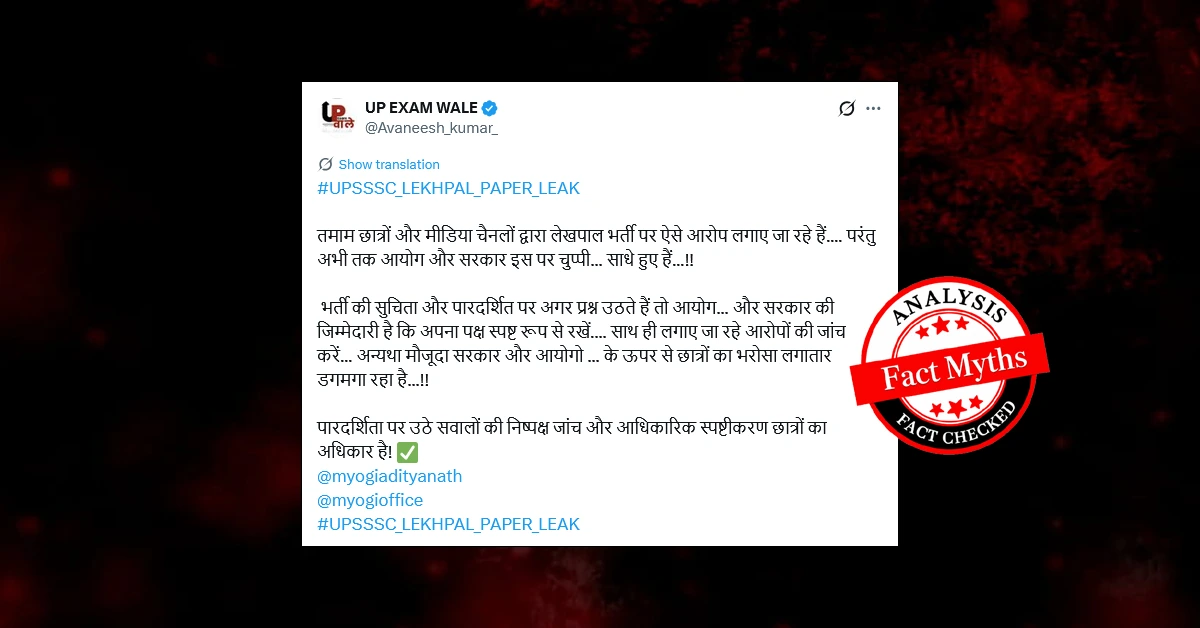
The posts use emotionally charged language, repeated slogans, and appeals to authority to create a narrative of a secret paper leak and governmental silence, encouraging mass sharing and distrust of the exam commission. Uniform phrasing across multiple users and omission of concrete evidence suggest coordinated framing rather than organic concern.
Key Points
- Repeated emotional triggers like “खामोशी”, “भरोसा टूट रहा है”, and “धांधली” amplify fear and anger.
- Identical wording such as “पारदर्शिता पर उठे सवालों की निष्पक्ष जांच और आधिकारिक स्पष्टीकरण छात्रों का अधिकार है” appears in several independent tweets, indicating a shared script.
- Reliance on authority titles (ADME, commission secretary) without independent verification, while dismissing opposing official statements as “भ्रम” or “असत्य”.
- Calls for users to “अधिक से अधिक शेयर करके इस मुहिम में” create a bandwagon effect and pressure to amplify the claim.
Evidence
- "सरकार और UPSSSC की खामोशी छात्रों का भरोसा तोड़ रही है" – emotional manipulation and appeal to fear.
- "अधिक से अधिक शेयर करके इस मुहिम में" – explicit call for viral sharing.
- "पारदर्शिता पर उठे सवालों की निष्पक्ष जांच और आधिकारिक स्पष्टीकरण छात्रों का अधिकार है" – repeated phrase across multiple accounts.
The content includes verifiable official statements, specific exam data, and citations of reputable news outlets, indicating a genuine effort to report both allegations and official rebuttals. The presence of detailed investigative steps (CCTV review, OMR security) and balanced presentation of perspectives are hallmarks of legitimate communication.
Key Points
- Official authorities (ADME, UPSSSC secretary, Information Department) are quoted with concrete details about the investigation.
- Multiple independent media sources (Dainik Jagran, Amar Ujala) are referenced, reinforcing the official narrative.
- Precise statistical information about registration and participation is provided, matching typical government releases.
- The narrative presents both the leak accusations and the official denial, showing an attempt at balanced reporting.
- Calls for transparent investigation are framed as civic engagement rather than coordinated agitation.
Evidence
- Statement by ADME Sanjay Singh that CCTV footage and invigilator testimony found no misconduct.
- Quote from Secretary Harikesh Chaursia about OMR sheets and sealed paper packets being secure.
- UP Information Department tweet citing 82.29% participation (3,01,756 of 3,66,712 candidates) and labeling the leak claim as "भ्रामक एवं असत्य".
- References to Dainik Jagran and Amar Ujala articles that echo the official findings.
- Inclusion of specific dates (21 May 2026 exam, 24 May 2026 tweets) and numbers (7994 positions, 861 centers).