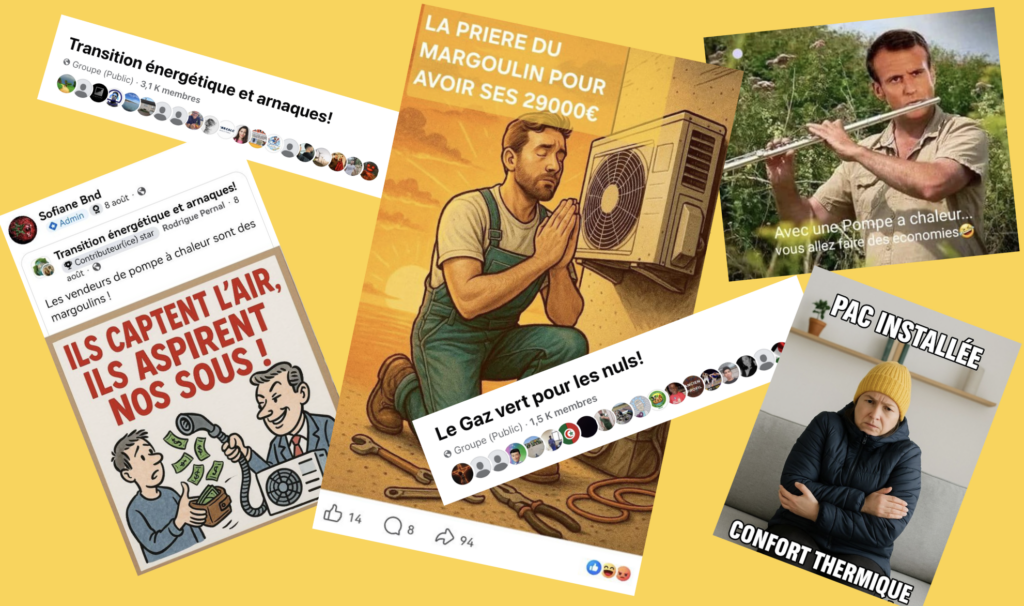
Both perspectives agree on the factual core – the article identifies a network of seven Facebook groups managed by a PR firm, documents AI‑generated graphics, and cites named experts and contract details. The critical perspective interprets these facts as evidence of coordinated manipulation (e.g., emotionally charged labeling of installers and antisemitic imagery), while the supportive perspective views the same facts as hallmarks of transparent investigative reporting. The dispute centers on intent and framing rather than on the veracity of the underlying data.
Key Points
- The factual elements (admin accounts, AI‑generated graphics, contract with Les Professionnels du Gaz, quoted experts) are corroborated by both analyses, indicating a solid evidentiary base.
- The critical perspective highlights manipulation patterns – coordinated inauthentic behavior, emotionally loaded language, and timing – and assigns high confidence (85%) to these claims.
- The supportive perspective stresses methodological transparency, source verification, and balanced outreach, assigning moderate confidence (68%) to the article’s credibility.
- Interpretation of the same evidence diverges: the presence of charged language and antisemitic tropes can be seen as manipulative or as reporting on genuine extremist tactics, affecting the overall manipulation assessment.
- Given the mixed evidence, a balanced score should reflect notable manipulation cues but also acknowledge legitimate reporting practices.
Further Investigation
- Obtain independent verification of the AI‑generated graphics and the extent of antisemitic imagery to assess intent.
- Review the full set of source materials (e.g., the 2025 IPIE report) to determine whether they are cited accurately and in context.
- Interview the quoted experts and the PR firm’s representatives to clarify the purpose of the campaign and whether the language was editorialized by the article’s author.
- Analyze the timing of the article’s release relative to policy debates to quantify any strategic alignment.
The article exhibits multiple manipulation patterns, including a coordinated inauthentic network, emotionally charged language targeting heat‑pump installers, and strategic timing to influence policy debate.
Key Points
- Coordinated inauthentic behavior: the same PR executive administers seven Facebook groups and uses duplicate AI‑generated graphics.
- Emotional manipulation: installers are labeled “swindlers”, “environmental fraudsters”, and depicted with antisemitic caricatures to provoke anger.
- Authority overload and selective sourcing: expert quotes are paired with unnamed DeSmog analysts and a speculative 2025 report to lend credibility while omitting counter‑evidence.
- Timing alignment: the investigation was released just before France’s electrification plan and EU boiler‑phase‑out discussions, suggesting agenda‑driven release.
- Missing context: no quantitative data on heat‑pump failure rates, cost‑benefit analyses, or alternative low‑carbon options are provided.
Evidence
- "Digital Tellers is linked to a web of connected Facebook groups and accounts, which regularly share false claims..."
- "installers are branded ‘swindlers’ (‘margoulins’) and ‘environmental fraudsters’ (‘éco‑délinquants’)"
- "Three of the graphics – which were posted in the groups by an admin and regular contributor – appear to be AI‑generated, and deploy antisemitic tropes"
- "The Digital Tellers director Barthélémy Vaudon – under the Facebook profile ‘Barth Vaudon’ – was an administrator on all seven groups"
- "A 2025 report from the International Panel on the Information Environment (Ipie)..."
The article includes several hallmarks of legitimate investigative reporting: named experts with affiliations, specific contractual details, attempts to obtain comment from all parties, and transparent description of the evidence‑gathering process.
Key Points
- Named, verifiable sources (e.g., Jonas Pardo, Laurent Cordonnier) are quoted and their institutional affiliations are provided.
- The report documents its methodology—identifying seven Facebook groups, admin accounts, and AI‑generated graphics—allowing independent verification.
- It records outreach attempts to the PR firm, the gas trade group, and Meta, and includes the firm’s denial, demonstrating balanced coverage.
- Concrete timestamps (first group in Feb 2021, contract dates) and contract specifics with Les Professionnels du Gaz give a traceable factual backbone.
- References to external, peer‑reviewed work (e.g., the 2025 IPIE report) place the findings within a broader research context.
Evidence
- Quote: “The drawings associate these visual tropes with money and social climbing,” explains Jonas Pardo, antisemitism expert at Boussole.
- Detail: “The Digital Tellers was hired … in a contract that included social media strategy, community management and content creation.”
- Transparency: “In a statement sent to DeSmog and Politico, a spokesperson for The Digital Tellers disputed the allegations… Meta declined to comment on record.”