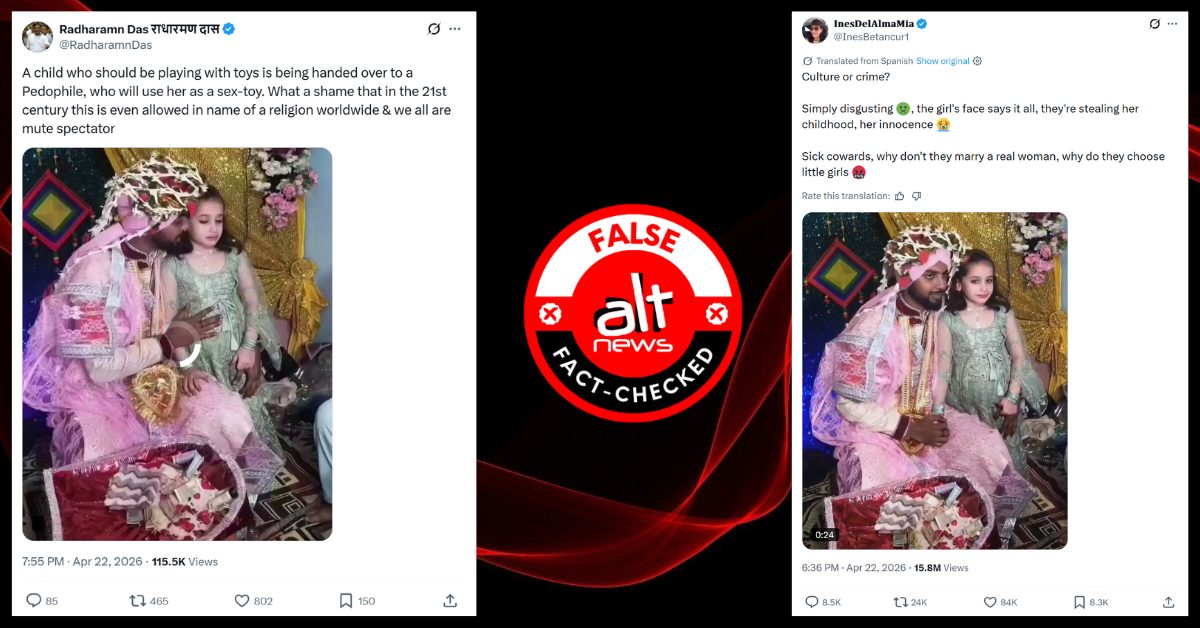
Both analyses agree that the original video caption identifies the participants as a maternal uncle and his niece, undermining the claim of a forced child marriage. The supportive perspective provides concrete forensic steps that can be independently reproduced, while the critical perspective highlights emotional language, a questionable authority, and coordinated timing that suggest manipulative framing. Weighing the stronger factual evidence against the noted presentation tactics leads to a moderate manipulation rating.
Key Points
- Forensic analysis (reverse‑image search, overlay text, Instagram links) shows the video depicts a familial relationship, not a child marriage.
- The critical view correctly notes emotionally charged language and coordinated posting, indicating manipulation of audience perception.
- The authority cited (Radharamn Das) has a documented history of misinformation, weakening the claim that the video proves a forced nikah.
- Both perspectives acknowledge the original caption "maternal uncle and niece," which contradicts the marriage narrative.
- Overall, the content appears factually credible but is presented in a manipulative manner, warranting a moderate manipulation score.
Further Investigation
- Obtain the full metadata and upload timestamp of the original video to verify its provenance.
- Map the exact timeline and network of accounts that shared the video to assess coordination and timing relative to political events.
- Review the statements and background of Radharamn Das to quantify his influence and any potential agenda.
The piece employs emotionally charged language, cites a partisan authority with a history of misinformation, and presents coordinated, timing‑sensitive messaging to amplify an Islamophobic narrative while omitting crucial contextual evidence.
Key Points
- Authority overload: Radharamn Das, an ISKCON official with a documented record of spreading communal propaganda, is foregrounded as an expert on Islamic marriage practices.
- Emotional manipulation & repetition: Repeated use of terms like "pedophile," "sex toy," and "robando su infancia" to provoke disgust and fear.
- Bandwagon & coordinated messaging: Multiple users and right‑wing influencers share near‑identical captions and hashtags within minutes, indicating a unified amplification strategy.
- Timing exploitation: The viral spread coincides with an anti‑Muslim rally in Delhi and the lead‑up to the June 2026 national elections, suggesting strategic release.
- Missing context & framing: The original video caption identifies the participants as "maternal uncle and niece," but this is only disclosed in the fact‑check section, while the narrative frames it as a forced nikah.
Evidence
- "...a "pedophile" who would treat her as a "sex toy.""
- "...the young girl's expression shows she is being robbed of her childhood and innocence."
- "...several users have shared the video with communal and Islamophobic claims..."
- "...Radharamn Das has a record of sharing misinformation and communal propaganda..."
- "...the clip’s caption explicitly identifies the two individuals as “maternal uncle and niece.”"
The piece follows a fact‑check methodology, citing verifiable sources, presenting concrete digital‑forensic steps, and providing multiple independent pieces of evidence that directly refute the viral claim.
Key Points
- Uses transparent investigative techniques (reverse‑image search, keyframe analysis) that can be independently reproduced.
- Cites the original video caption and overlay text that explicitly label the participants as "maternal uncle and niece," contradicting the marriage narrative.
- Cross‑references several related Instagram accounts (the mother’s account, the uncle’s personal profile, the sister’s highlights) that consistently show a family wedding context and an adult spouse for the uncle.
- Provides multiple corroborating media artifacts (additional wedding videos, ring‑finding ritual) that demonstrate the uncle is married to an adult, not the child.
- Acknowledges the prior misinformation history of certain sharers, demonstrating awareness of bias rather than ignoring it.
Evidence
- Google Reverse Image Search on keyframes linked to a YouTube Shorts channel where the caption reads "maternal uncle and niece."
- Overlay text in the video states: "A niece is not just the first daughter to her parents, but also to her maternal uncle," indicating a familial relationship.
- Instagram watermark @rukhsar_mulla20 leads to the child’s mother’s account, which contains multiple videos of the same uncle at a family wedding and shows his adult wife in other posts.