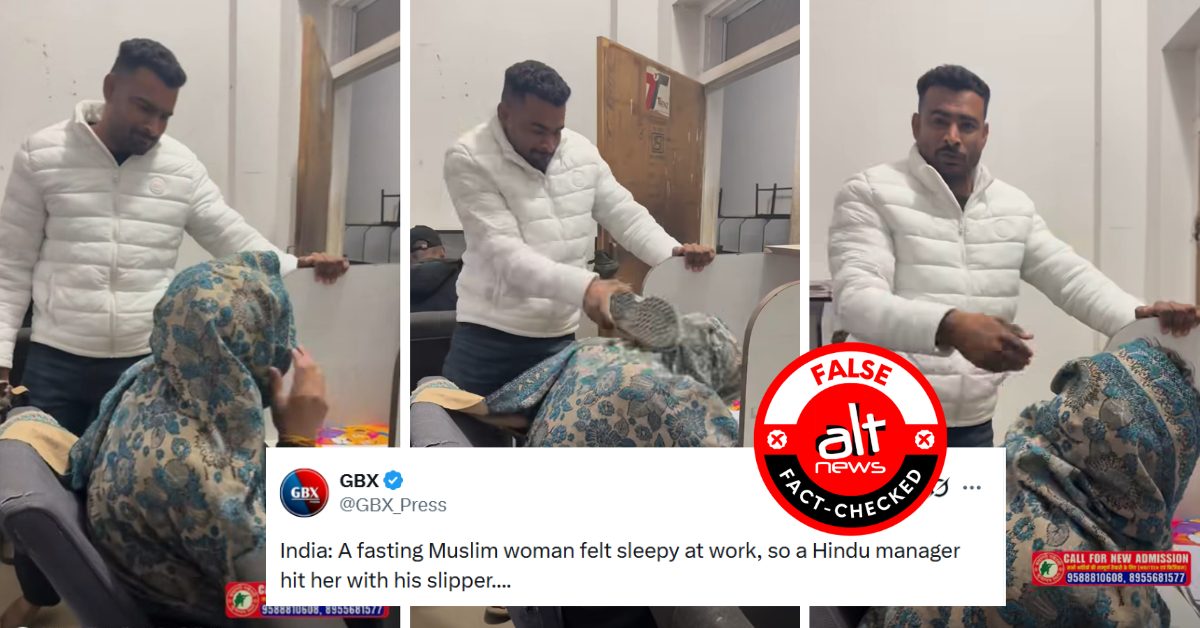
Both the critical and supportive perspectives converge on the conclusion that the viral claim about a "fasting Muslim woman" being slapped by a Hindu manager is false and stems from a video of a male student at a coaching institute. The critical perspective emphasizes the manipulative framing, emotional triggers, and bandwagon cues used to stoke communal tension, while the supportive perspective validates the fact‑check’s forensic methodology that disproves the claim. Together, the evidence points to coordinated misinformation rather than a credible incident.
Key Points
- Both analyses agree the video actually shows a male student at a Jaipur coaching institute, not a Muslim woman being assaulted.
- The critical perspective identifies manipulation tactics (communal framing, emotional exploitation, popularity cues) that suggest deliberate intent to inflame communal sentiment.
- The supportive perspective demonstrates a rigorous fact‑checking process (watermark analysis, reverse‑image search, timeline verification) that substantiates the misrepresentation.
- The alignment of these independent lines of evidence strengthens the assessment that the content is highly manipulative and not credible.
- Further verification of the video's origin and propagation network would solidify the conclusion.
Further Investigation
- Obtain the original upload metadata (timestamp, uploader) to confirm the video’s provenance.
- Interview the alleged victim (the male student) and the institute’s management for corroboration.
- Map the spread of the video across platforms to identify coordinated amplification networks.
- Examine any edits or overlays added to the video that may have altered its context.
The content employs communal framing, emotional triggers, and selective omission to provoke outrage against a perceived Hindu aggressor and Muslim victim, while leveraging view counts to suggest mass endorsement. These patterns indicate coordinated manipulation aimed at deepening tribal divisions.
Key Points
- Communal framing ("fasting Muslim woman" vs "Hindu manager") creates a clear us‑vs‑them narrative.
- Emotional manipulation through the slap with a slipper and the mocking "Good morning" phrase exploits religious fasting sensitivities.
- Bandwagon cues – mention of >2 million views and >1,000 reshares – encourage acceptance based on popularity.
- Critical context is hidden (the incident actually involves a male student at a coaching institute in Jaipur), leading to a misleading interpretation.
- The story surfaced amid other anti‑Muslim incidents, suggesting opportunistic timing to amplify communal tension.
Evidence
- "A fasting Muslim woman felt sleepy at work, so a Hindu manager hit her with his slipper."
- "Good morning" between blows
- "At the time of this article being written, the post has gathered more than 2 million views, and has been re‑shared on X more than 1,000 times."
- The fact‑check finds the watermark referring to "Commando Academy" and identifies the video as a coach waking a male student, not a Muslim woman.
- The timing note: "The story surfaced on March 26, 2026, just after multiple anti‑Muslim attacks were reported in the UK and US..."
The piece follows a transparent fact‑checking workflow, cites multiple independent digital artefacts, and presents a step‑by‑step refutation of the viral claim, all hallmarks of legitimate communication.
Key Points
- Forensic verification – reverse‑image search, watermark analysis, and matching the logo to a real coaching institute’s branding.
- Multiple independent sources – the original Instagram reel, the institute’s website, the founder’s Facebook/Instagram posts, and an interview conducted by Alt News.
- Chronological consistency – the original video is dated 13 Feb, the Instagram reel appears 19 Mar, and the fact‑check was published after these dates, showing a coherent timeline.
- Balanced narrative – the article first reproduces the circulating claim, then systematically dismantles it with evidence, without resorting to unverified accusations.
- Transparency about methodology – the author explains each investigative step and provides links (or references) to the underlying material.
Evidence
- A reverse‑image search of a keyframe led to an Instagram Reel uploaded on 19 Mar that explicitly labels the setting as an educational institute.
- The bottom‑right watermark reads “Commando Academy,” which matches the logo and phone numbers on the institute’s official website in Jaipur.
- The founder, Veerat Choudhary, has a Facebook profile where the same video was originally posted on 13 Feb, and he later posted a clarification video on his Instagram account stating the subject was a male student, not a woman.