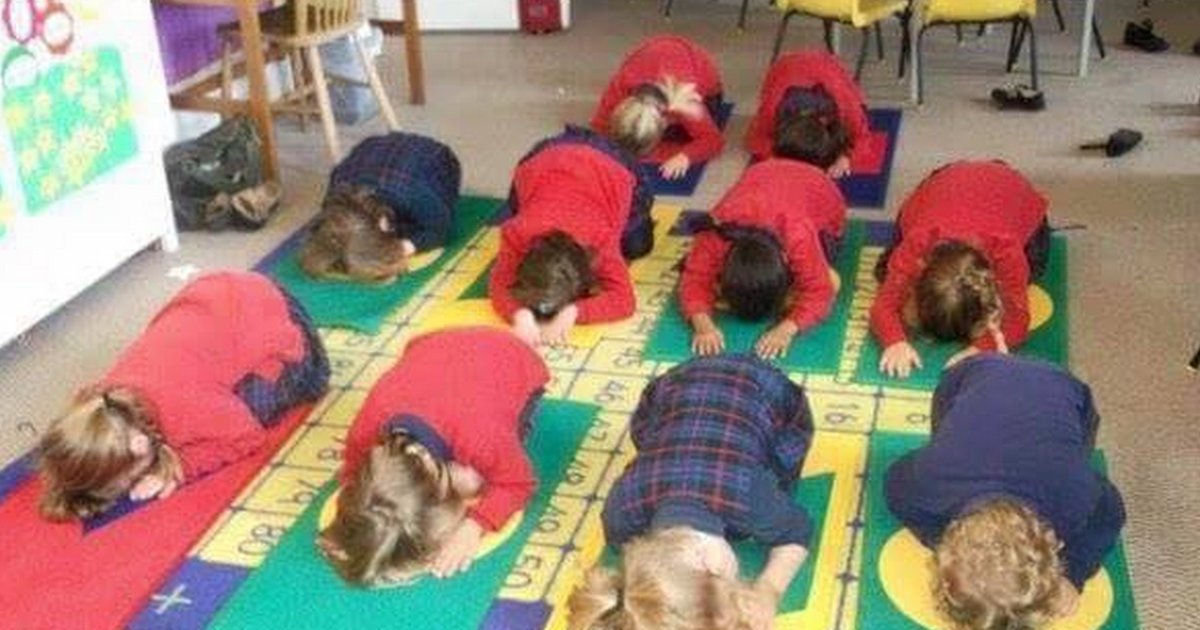
Both analyses agree the post is about a school yoga photo linked to claims of "Islamification," but they differ on how suspicious the content is. The critical perspective highlights manipulative framing, emotional language, false equivalence, and reliance on unverified authority, suggesting a coordinated narrative. The supportive perspective points to seemingly organic user engagement (shares, comments, dissenting voices) as evidence of authenticity. Weighing the textual evidence of manipulation against the plausibility of fabricated engagement, the balance tilts toward the critical view: the post shows several classic manipulation cues, and the supportive cues do not conclusively prove organic origin.
Key Points
- The post uses loaded terms (e.g., "heartbreaking," "Islamification of Britain") and identity‑based slogans, which are hallmark emotional manipulation techniques.
- It draws a false equivalence between a common yoga pose (balasana) and the Islamic sajdah prayer without providing verifiable evidence of intent.
- While the post includes dissenting comments and share metrics that could indicate organic spread, such details can be fabricated and do not offset the identified framing and authority overload.
- Critical contextual information (school name, curriculum purpose, source of the pose description) is missing, limiting the ability to verify the claim independently.
- Both perspectives note the presence of anonymous or non‑expert voices (e.g., Richard Dickinson, Noori Akhtar) used to lend credibility, which weakens the authenticity argument.
Further Investigation
- Identify the specific school and obtain its official curriculum or activity schedule to confirm whether the pose was presented as a religious practice.
- Locate the original source of the claim (e.g., the initial social‑media post) to verify the context of the comments and share counts.
- Interview teachers or administrators at the school (or review public statements) to determine the intended purpose of the yoga session.
- Analyze the metadata of the image and post (timestamps, platform origin) to assess whether the engagement metrics are likely organic or artificially inflated.
The post uses emotionally charged language and selective framing to portray a routine school activity as evidence of an "Islamification" agenda, employing false equivalence, tribal rhetoric, and unverified authority to stoke fear and outrage.
Key Points
- Emotional manipulation through loaded terms like "heartbreaking" and "Islamification of Britain" creates a moral panic.
- False equivalence equates a standard yoga child's pose (balasana) with the Islamic sajdah prayer without substantive proof.
- Tribal division is reinforced by identity‑based slogans such as "We are British not Muslim" and calls to expel Muslims.
- Authority overload relies on anonymous or non‑expert voices (e.g., Richard Dickinson, Noori Akhtar) to lend credibility to the claim.
- Critical contextual details (school name, curriculum purpose, verification of the pose’s intent) are omitted, leaving the narrative one‑sided.
Evidence
- Caption: "A British school. Heartbreaking."
- Comment: "Islam should not even be mentioned in our schools it's about time we sorted this out this (sic) is Britain we are British not Muslim. Get them out of our country."
- Article statement: "The yoga pose is known as balasana, or child’s pose. The position is similar to the final position of the Muslim pray ritual - a move called sajdah..."
- Noori Akhtar’s remark: "typical game of sleeping lions/sleeping bunnies!!!!!!!!! Oh how you love to stir the s***!!!"
- Absence of school identification or official explanation of the activity.
The post contains raw user comments, share and comment counts, and includes skeptical voices, which are modest signs of organic, user‑generated content rather than a tightly scripted propaganda piece.
Key Points
- Presence of dissenting, skeptical comments that question the premise (e.g., Nati Moore, Eloise Manuel).
- Absence of formal citations or official statements; the material reads like a repost of a social‑media claim rather than a polished press release.
- Specific quantitative details (1900 shares, 11 000 comments) that would require a source to fabricate convincingly.
- Limited direct call‑to‑action – only a vague suggestion to sack the headmaster, reducing evidence of coordinated mobilisation.
Evidence
- "The picture has been shared over 1900 times and has prompted 11,000 comments."
- "Nati Moore wrote: \"Looks like they are doing yoga to me 🙄 these photos can easily have been taken out of context!\"
- "Eloise Manuel posted a series of questions under the image..."
- "Richard Dickinson wrote: \"That school should have the headmaster sacked.\"