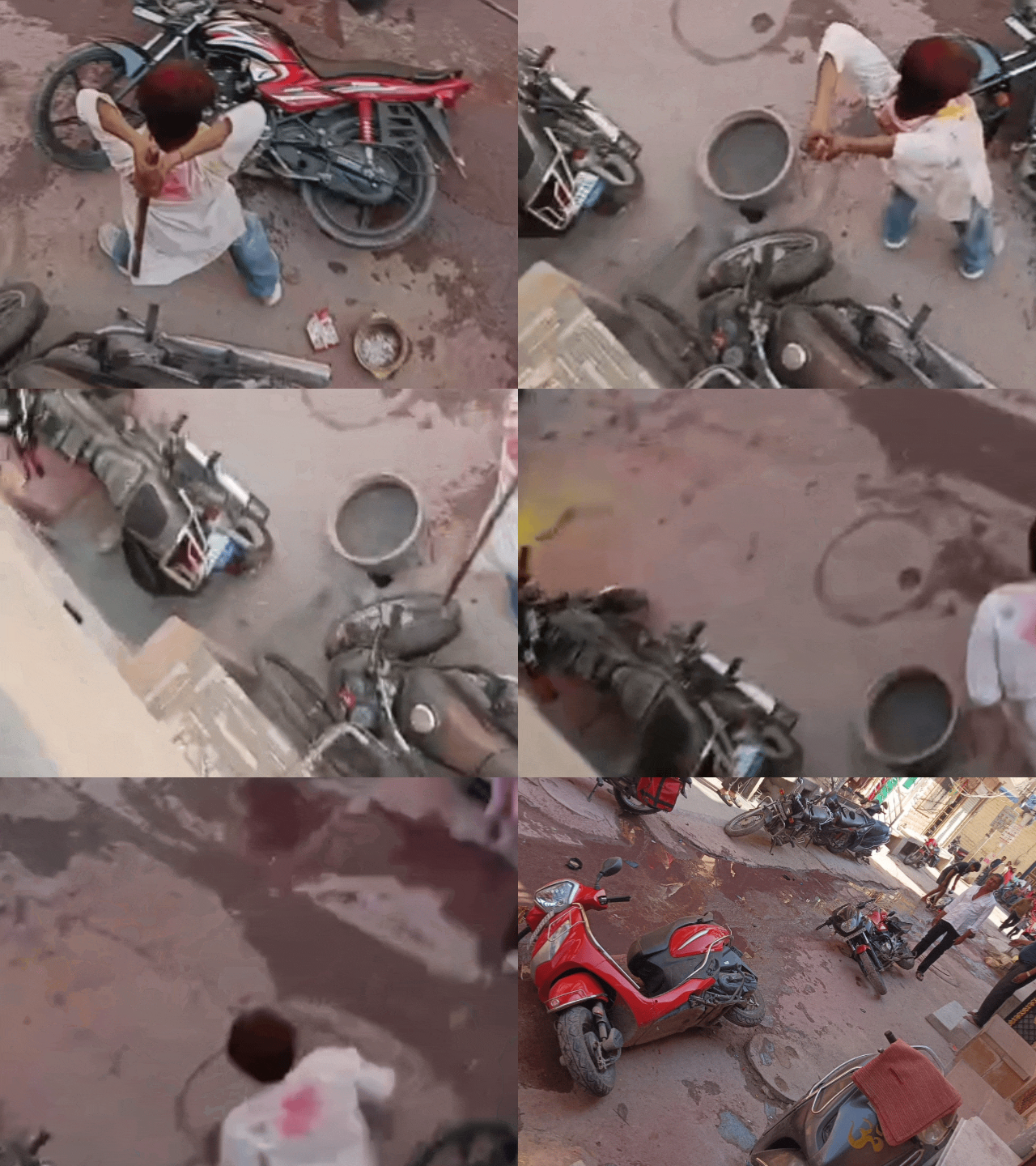
Both analyses agree the article contains concrete details (named officers, location, CCTV) but differ on the weight of its emotive language and contextual gaps. The critical perspective highlights fear‑inducing quotes, heavy reliance on police authority, and repeated headlines as signs of coordinated framing, while the supportive perspective emphasizes the presence of verifiable specifics and a neutral reporting tone. Weighing the evidence, the piece shows some manipulative elements but also standard local‑news reporting features, suggesting a moderate level of manipulation.
Key Points
- The article includes specific, verifiable details (officer names, exact time and place, CCTV reference) supporting authenticity.
- Fear‑laden language (e.g., "शिकायत की तो एक-एक को मार देंगे") and repeated headline phrasing point to potential emotional manipulation and coordinated messaging.
- Reliance on police statements without independent corroboration and omission of broader context (motives, legal outcomes) weaken the article's completeness.
- Both perspectives note the same factual elements, indicating that the evidence base is shared; the divergence lies in interpretation of tone and framing.
Further Investigation
- Obtain independent verification of the incident (e.g., court records, statements from non‑police witnesses).
- Analyze the distribution network of the identical headline to determine whether it stems from syndication or coordinated amplification.
- Gather follow‑up reporting on motives, community response, and legal outcomes to assess completeness of coverage.
The article employs fear‑inducing language, heavy police authority framing, and selective omission of context, while echoing identical phrasing across outlets, suggesting coordinated narrative shaping rather than pure reporting.
Key Points
- Use of threatening quotations (e.g., "शिकायत की तो एक-एक को मार देंगे") creates emotional manipulation through fear
- Reliance on police officials (DCP, ACP) without independent corroboration overloads authority cues
- Framing language such as "बदमाशों" and "खौफ" paints perpetrators as villains and police as protectors, simplifying the narrative
- Key details (motives, broader community response, legal outcomes) are omitted, leaving an incomplete picture
- Identical headline phrasing across multiple Hindi news sites indicates uniform messaging, a hallmark of content syndication or coordinated amplification
Evidence
- "शिकायत की तो एक-एक को मार देंगे" – direct threat quoted to evoke fear
- "डीसीपी (पश्चिम) विनीत कुमार बंसल ने बताया... एसीपी (प्रतापनगर) रविन्द्र बोथरा के निर्देशन में विशेष टीम गठित" – authority citations without external verification
- Words like "बदमाशों", "खौफ", "धमकी" repeatedly used to frame the youths negatively
- Absence of information on perpetrators' motives, community initiatives, or judicial follow‑up
- Repeated headline "10 गाड़ियों में तोड़फोड़ करने वाले दो गिरफ्तार" appears on several sites within hours, showing uniform messaging
The article provides concrete details such as named police officials, specific locations, dates, and references to CCTV footage, which are typical of routine local news reporting. It avoids overt calls for action or partisan framing, suggesting a primarily informational intent.
Key Points
- Specific names and ranks (DCP Vinod Kumar Bansal, ACP Ravindra Bothra) are included, indicating sourceable authority.
- Reference to CCTV footage and eyewitness reports gives verifiable evidence of the investigation.
- The piece reports both the criminal acts and the police response without praising or condemning any political entity.
- No direct solicitation for audience action or donation, and language stays within factual description despite emotive quotes.
Evidence
- Mentions DCP (West) Vinod Kumar Bansal and ACP (Pratap Nagar) Ravindra Bothra as spokespeople.
- States that police examined CCTV footage and used informant tips to locate suspects.
- Provides exact time (around 1 pm) and location (K‑207 area, Indira Colony) of the incident.
- Quotes a threat verbatim: "शिकायत की तो एक-एक को मार देंगे" which appears as a direct report rather than editorialized language.