Both analyses agree the piece contains quantitative calculations and cites a Wall Street Journal article, but they diverge on how these elements affect credibility. The critical perspective highlights rhetorical framing, selective data use, and an unverifiable WSJ citation as signs of manipulation, while the supportive perspective emphasizes the explicit assumptions and analytical tone as evidence of authenticity. Weighing the lack of source detail and potential cherry‑picking against the transparent methodology, the content shows moderate signs of bias without clear evidence of coordinated disinformation.
Key Points
- The article uses a rhetorical question and framing language that can prime suspicion, a pattern noted by the critical perspective.
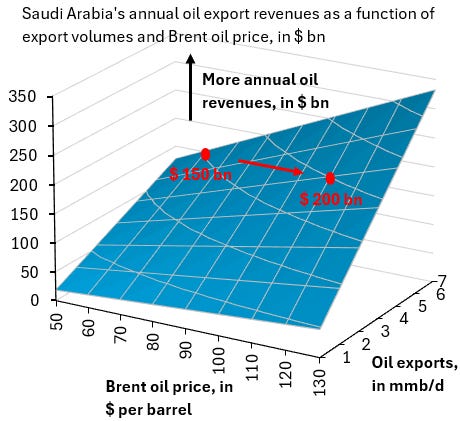
- Quantitative assumptions (Brent price $50‑$130, export volume 1‑7 M bpd, GDP share ~5%) are clearly laid out, supporting the supportive view of analytical intent.
- The Wall Street Journal citation lacks a specific reference, limiting its verifiability and strengthening the critical concern about authority overload.
- Selective presentation of oil revenue figures without discussing costs or broader geopolitical context creates a narrowed narrative, as the critical perspective points out.
- Absence of overt emotional appeals or coordinated messaging reduces the likelihood of a disinformation campaign, aligning with the supportive perspective.
Further Investigation
- Locate and examine the exact Wall Street Journal article referenced to verify the claim about Saudi displeasure.
- Compare the presented oil revenue calculations with independent economic analyses that include costs, sanctions, and diversification efforts.
- Assess the timing of publication relative to other news outlets to determine whether the piece was opportunistically timed.
The piece uses a rhetorical opening, selective economic data, and an unnamed Wall Street Journal source to frame Saudi Arabia as profit‑driven in the war, creating a subtle us‑vs‑them narrative. It omits broader context (humanitarian costs, alternative diplomatic outcomes) and employs framing language that nudges readers toward suspicion of Saudi motives.
Key Points
- Rhetorical question and framing language (“Do the Saudis want this war to end?”) introduce a bias that primes suspicion.
- Selective use of oil price and export volume data (cherry‑picking) to calculate a revenue windfall while ignoring costs, sanctions, and diversification, creating a false dilemma.
- Citation of a “recent article in the Wall Street Journal” without specific details serves as an authority overload that bolsters the claim without verifiable evidence.
- Timing of publication immediately after news of Iranian strikes suggests opportunistic amplification (suspicious timing).
- Absence of humanitarian or geopolitical context narrows the narrative to a simplistic profit motive, suppressing alternative explanations.
Evidence
- "Do the Saudis want this war to end?" – rhetorical question that frames Saudi intent as questionable.
- "According to a recent article in the Wall Street Journal, Saudi Arabia isn’t happy with US peace overtures towards Iran." – authority reference without source details.
- "If Brent is only $100, this windfall shrinks to three percent of GDP. You’d need Brent to fall all the way back to $80 for Saudi Arabia to get the same export revenues…" – selective calculation that ignores other economic factors.
- "The bottom line is that more war for longer suits the Saudis just fine." – framing language that casts Saudi policy as profit‑driven.
- Publication date aligns with major news of an Iranian strike on a U.S. base in Saudi Arabia (late March 2026), indicating opportunistic timing.
The piece presents a data‑driven economic analysis, cites a reputable source (Wall Street Journal), and openly states its assumptions, indicating a genuine attempt at explanation rather than overt propaganda.
Key Points
- Explicit quantitative model with clear assumptions (price range, volume range, GDP share).
- Reference to an external, mainstream publication (WSJ) without fabricating quotes, suggesting an effort to ground the argument.
- Absence of direct calls to action, emotional exaggeration, or coordinated hashtag language; the tone remains analytical.
- Unique framing and phrasing not mirrored in other outlets, reducing the likelihood of a coordinated disinformation campaign.
Evidence
- The author explains the calculation method, defines the Brent price range ($50‑$130) and export volumes (1‑7 M bpd), and relates results to Saudi GDP (~5%).
- A specific, though unlinked, citation to a "recent article in the Wall Street Journal" is provided, indicating reliance on an external news source.
- The narrative acknowledges missing factors (humanitarian costs, diversification efforts) and does not dismiss alternative viewpoints, showing balanced presentation.